Ann Fenwick’s gravestone in St Wilfrid’s Church, Melling
A short history compiled for St Wilfrid’s Church, Melling.
by D.J. Shannon.
2026.
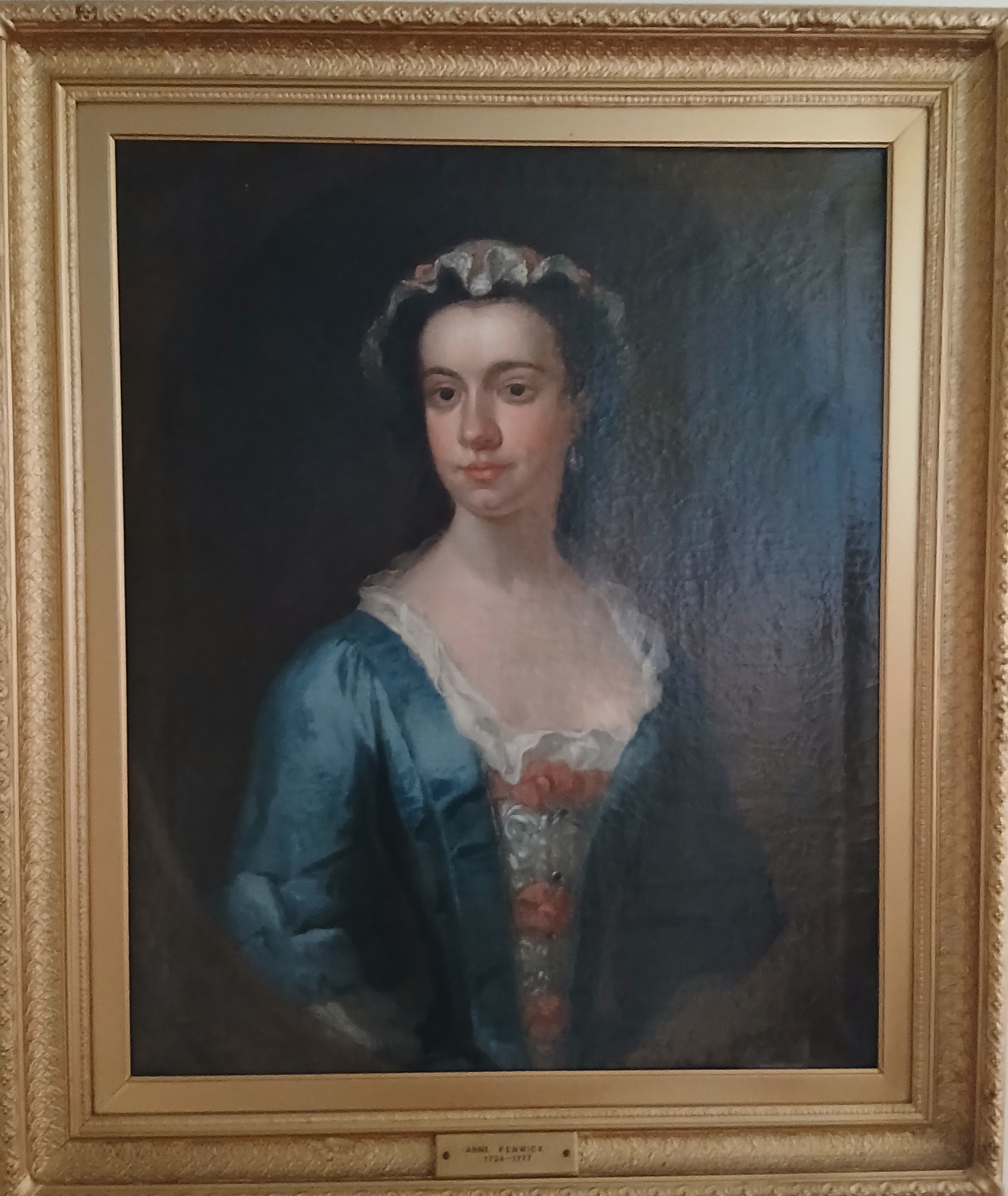
Ann Fenwick of Hornby (1724-1777)
Ann is primarily known for winning a 10-year long court battle, reinstating her fortune, when being a Roman Catholic “recusant” and a woman, presented many legal and social difficulties.
Ann is buried on the main aisle, at the chancel of St Wilfried’s Church, Melling, where you can see her memorial stone, alongside her parents, Thomas Benison (Died 1738) and Ann Winder Benison (Died 1762).
Early Life
Ann was born in Hornby to a Protestant father, who was a prominent lawyer, and a Roman Catholic mother, who had been well educated in an illegal Catholic School in Hammersmith, London. They lived at Hornby Hall in Hornby. Ann’s father died when she was 14 years old and she inherited £900 a year and his estate, and in 1737 she also inherited from her uncle. Her Catholicism is not recorded in that context and perhaps her young age and Father’s Protestantism, allowed her to inherit, without penalty. Ann was educated by her mother at home and became a devout, practicing Catholic, known for her compassion and charity work.

Hornby Hall and Castle (c.1736 Arthur Devis). Lancashire County Museum Service.
Being a Roman Catholic in the 18th Century
At the time when Ann lived, it was illegal to be a Catholic and this only changed in 1791. Catholics who owned land often lost this or converted, due to the many penalties they faced. The Morley family of Wennington Hall, near to Hornby, were fined heavily for being Catholics and had to sell their estates in 1674. In 1700, there were 400 Catholic landowners in England, and this fell to 200 by 1770. At this time, legally, Catholics could not own or inherit land, and they could not travel more than 5 miles away from where they lived. They were fined and sometimes imprisoned for taking part in Mass or for hiding a Priest. Some laws were not always enforced and whilst leniency and toleration did exist, this could change suddenly, for example after the Jacobite Rebellion in 1745.
Marriage and the difficulty of women’s financial reliance on men.
Ann married John Fenwick of Burrow Hall in 1753. John was a Protestant and his estate was worth £3000 per annum. It was described as “a marriage of affection” at the time.

(Newspaper announcement of John Fenwick and Ann Benison’s marriage.)
The couple lived at Burrow Hall. Ann gave her estate temporarily to her husband, regarding increasing his collateral but this also may have been in part, to circumnavigate financial penalties placed on Catholics.

Burrow Hall (c. 1824) Creative Commons.
Sadly, John died in Feb 1757, just five years after the wedding, in a hunting accident. Ordinarily, widows who had no children would be entitled to a third of their husband’s estate and property where there was no will. However, John’s original pre-marriage Will stated that his estate and property should go to his brother, Thomas Wilson (Fenwick), in the event of him being childless.
Ann was left with potentially nothing and this placed her in a very difficult position.
John Fenwick’s brother, Thomas Wilson took the name Fenwick to inherit, as had been stipulated by his grandfather. He was a Lawyer at Gray’s Inn, who became MP for Westmoreland in 1768. He was considered somewhat “eccentric” at the time and often had debts. He spent much of his time in London.
Ann continued to live at Burrow Hall once widowed. She looked after her 6-year-old niece, Elizabeth Dowker from 1757 for a few years and she relied on her Brother-in-Law to maintain her financially.
Ann and Thomas’ lawyers agreed in 1759 that she would receive a lump sum of £3000; use of the Hall during her lifetime and an Annuity of £500 a year, whilst her mother was alive and £100 after her mother’s death. At the time, social conventions were that a man’s duty would be to protect women in his family financially and Ann relied on this convention and accepted the arrangement.
In 1760 Ann reportedly “fled” to Hornby Hall, where her mother lived and she asked Thomas in a letter to be allowed to go back and get her belongings, which was agreed. However, there is no further information as to why she had to leave so suddenly. After her mother’s death in 1762, she resorted to asking tenants for rent from her estate to supplement her funds due to lack of payment of her Annuity.
Ann’s Catholic Mission
In 1717 it was recorded that there were 48 “Papists in the parish of Melling” (Which covered a large area) and by 1767 there were 98 Papists at Hornby, 7 at Arkholme and 2 at Melling.
What funds Ann did have went into the formation and maintenance of a Catholic mission in Hornby and Claughton and she engaged Thomas Butler, (trained at Douai) as mission Priest in Hornby from 1761, and he celebrated Mass at Hornby and Claughton. Ann amassed a library of “Catholic-leaning” books and openly supported the Jacobite rebellion and “Bonnie Prince Charlie’s” attempt to reinstate Catholics on the throne of England. This would perhaps have been considered as being too overtly “Catholic” by her Protestant family and neighbours and this may have partially influenced Thomas’ reluctance to supply her with funds. 
(In 1745, Charles Stuart proclaimed his father to be the rightful King at the Market Cross in Lancaster. This proclamation was met with “indifferent silence”, and he gained little support in the city).
Increasing desperation
At first, Thomas paid what was due to Ann, but his payments became increasingly intermittent and her many letters pleading for money were often left unanswered. Ann became increasingly unwell and in 1765 she went to Bath for treatment. Whilst there, she met William Pitt the Elder, who became Prime Minister in 1766. By 1768 Thomas had stopped sending any money to her at all and she resorted to borrowing money from her servants to pay debts.

Press article announcing the sale of the Estate. November, 1772.
Defending her rights through the law
By the late 1760’s, the threat of Debtors prison loomed large for Ann, as legal suits were increasingly sought against her and she still had no response from her brother-in-law. She went to court in 1770 and sued Thomas for £18,000. Her situation was difficult. Thomas Fenwick was an MP, and she was a woman and a known Catholic recusant. However, in December, the court found in her favour. Thomas appealed and then delayed and subsequently his personal estate was found “not sufficient” to cover the amount he needed to pay her.
In 1772, Ann sought a Private Act of Parliament through the House of Lords to obtain her estate. She argued that Thomas had taken advantage of her financial “ignorance”. She cleverly argued that the lands and estate that were hers should be sold, rather than go back to her, so they could remain in “Protestant” hands. She won the case and in 1772 the land was sold.
Thomas Fenwick’s reputation and social standing were significantly damaged by the case. His financial position also suffered. He was not re-elected as an MP.
Ann’s death and legacy
Ann died in 1777 and she left funds to build a chapel in Hornby. In 1778, The Catholic Relief Act was passed, which allowed Catholics to legally own land and inherit.
In 1780 Edmund Burke (Whig Politician and supporter of Catholic Emancipation) used Ann’s story to carry a political message about responsibilities - the duty, virtue and honour of men to be “good protestants and good citizens” and for the law to be used to fight against injustice and the vulnerability of women.
Her case appears highly influential in bringing about easing of penal laws and in the subsequent Catholic Emancipation Act of 1829. Subsequently, in more recent times, Ann has been seen as a champion of Lancashire Catholics.
References
British History Online. www.british-history.ac.uk.
Drummond, Mary M. The History of Parliament: British Political, Social and Local History. Fenwick, Thomas (?1729-1794) of Kentmere, Westmoreland. Historyofparliamentonline.org. ret. 03.03.2026.
Gillow, J (1885) A literary and Biographical history or biographical dictionary of the English Catholics from the breach with Rome in 1534 to the present time. (https://archive.org).
Lancaster City Council Place-Names of the Lancaster District - Lancaster City Council
Loach, W. “Ann Fenwick of Hornby: British Catholicism and the state of Hanoverian England” (2025) MA Dissertation. University of Ottawa
With thanks to Mrs Clare Wright for additional Newspaper research.
The following Newspaper article is regarding Ann’s father, Thomas Benison, on his death in 1738. The puzzling words referred to in Latin translate as “And no one requires him to be raised from the dead”. Puzzling indeed!

Download: Ann Fenwick - a short history